 Seasons...
 2026
2026
•
•
•

Ciné Gael Montréal Irish Film Series 2026 ...our 34th
2026 is the 100th Anniversary of the establishment of Fianna Fáil in 1926.
As well, it's the 200th anniversary of the replacement of Irish currency with the Irish Pound in 1826.
The series that our film programmers
have assembled is an exciting fresh look at recent Irish filmmaking.

In 1992, the Cultural Committee of the St. Patrick's Society of Montréal
received a proposal from film-buff Anthony Kirby that Montréal needed an Irish film series; as it happens, Kevin O'Higgins,
one of Anthony's uncles, was in the government of the Free State in those early years.
The committee agreed to fund the wildly hysterical plans of Lynn Doyle, Patrick Vallely
and several other miscreants, to form and run a film society devoted to showing Irish Films.
The name Ciné Gael Montréal was proposed and scheduling and film selection started, with outside assistance coming from Fr. Marc Gervais SJ, Peter Rist, Ben Queenan, and most importantly, the film archives and screening facilities at Concordia University. Early in 1993, we screened our first film, The Commitments (1991).
On our 20th anniversary, when we asked our members to tell us the film from our past seasons that we should show again, it was that first film.
Read more about our history, written by Dana Hearne on our 10th and our 15th anniversary, as well as John Griffin's article from the Gazette, written on our 20th anniversary in January 2012. This is our film schedule flyer for 1993, front and back.

Concordia University, 1400 de Maisonneuve West, at 7:15 PM, unless otherwise indicated.


 Anne McCabe is an Irish author, writer and a television director who has won
many awards for her social documentaries and original TV drama.
Anne McCabe is an Irish author, writer and a television director who has won
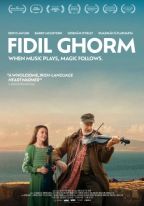
many awards for her social documentaries and original TV drama.1h 26m - Dir Anne McCabe; writer - Patricia Forde
Produced by Abú Media Coimisiún na Meán - Irish language with English sub-titles
with: Edith Lawlor, Barry McGovern, Siobhán O'Kelly, Aindrias De Staic
 "Anne McCabe, a vastly experienced television director, begins an Fidil Ghorm with a close-up of Lawlor’s sand-smeared face
as her character Molly recalls happy family times at the beach, and her father Ruraic’s (Aindrias De Staic)
nightly request to share the best and worst things that have happened during her day. One particular day was, however,
marked by events that leave Ruraic in a coma. Her brother Jack (Ruadhan Flatharta) has been struck dumb ever since.
Three months later, there has been no improvement in either condition, and Ruraic is moved to a rehab centre.
Molly, though, has never lost faith that he will recover."
- www.screendaily.com
[Allan Hunter]
"Anne McCabe, a vastly experienced television director, begins an Fidil Ghorm with a close-up of Lawlor’s sand-smeared face
as her character Molly recalls happy family times at the beach, and her father Ruraic’s (Aindrias De Staic)
nightly request to share the best and worst things that have happened during her day. One particular day was, however,
marked by events that leave Ruraic in a coma. Her brother Jack (Ruadhan Flatharta) has been struck dumb ever since.
Three months later, there has been no improvement in either condition, and Ruraic is moved to a rehab centre.
Molly, though, has never lost faith that he will recover."
- www.screendaily.com
[Allan Hunter]
"Director Anne McCabe opens with long, wistful images of the western Irish coastline. She films County Donegal over the credit sequence, depicting it with such warmth that the audience understands why musicians congregate there. McCabe’s protagonist is Molly (Edith Lawlor), a 10-year-old girl whose idyllic life is put into a tailspin after her father (Aindrias De Staic) falls into a coma. At the rehab center where Molly awaits his recovery, she meets cranky Malachy (Barry McGovern), an accomplished fiddle player. Molly becomes convinced Malachy possesses some mystical power, one that can only be unlocked through music. She convinces him to give her music lessons—all in hope of magically healing her dad." - washingtoncitypaper.com [Alan Zilberman]
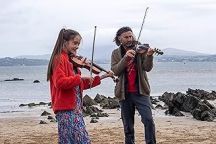
 "A beautiful, contemporary Irish-language movie, an Fidil Ghorm is one for all of the family;
bringing together traditional Irish music and culture and the innocence and resilience of 10-year-old Molly,
who’s on a heartfelt mission to bring her father out of a coma. Believing that winning the
All-Ireland Fiddle Competition might wake him, she’s determined to follow in his musical footsteps and invoke the magic in the music."
- ACMI
"A beautiful, contemporary Irish-language movie, an Fidil Ghorm is one for all of the family;
bringing together traditional Irish music and culture and the innocence and resilience of 10-year-old Molly,
who’s on a heartfelt mission to bring her father out of a coma. Believing that winning the
All-Ireland Fiddle Competition might wake him, she’s determined to follow in his musical footsteps and invoke the magic in the music."
- ACMI
"A charming heartwarming family drama, an Fidil Ghorm is like a warm hug that follows a recent revival of award-winning Irish language films such as The Quiet Girl (An Cailín Ciúin), Roisin and Frank and Arracht." - irishfilmfestivalottawa.ca
 McCabe and cinematographer Ronan Fox share Molly’s innocent wonder at the beauty and magic in the land around her.
The rehab centre lies on a sunny bay and the drama is punctuated by images of glowing sunsets, the gentle crash of waves on rocks,
a robin chirruping on a tree branch. The story itself is predictable but heartfelt. Molly has shown some promise as a fiddler
and believes that, by winning a national competition, she might be able to heal her father, himself a prize-winning fiddler.
McCabe and cinematographer Ronan Fox share Molly’s innocent wonder at the beauty and magic in the land around her.
The rehab centre lies on a sunny bay and the drama is punctuated by images of glowing sunsets, the gentle crash of waves on rocks,
a robin chirruping on a tree branch. The story itself is predictable but heartfelt. Molly has shown some promise as a fiddler
and believes that, by winning a national competition, she might be able to heal her father, himself a prize-winning fiddler.
Lawlor makes Molly an appealing figure but even more impressive is her ability with the fiddle – she plays with the flair
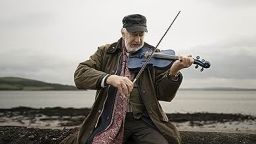
and touch of a veteran. Among the residents of the genteel rehab centre is grumpy old widower Malachy (Barry McGovern),
a star fiddler of old whose dodgy ticker has now condemned him to a quiet life. Naturally, the crusty exterior conceals
a heart of gold, and soon Malachy has agreed to coach his willing young pupil.
His cherished blue fiddle provides the film with its title.
The relationship between Molly and Malachy is nicely handled with her belief that he might be a druid miracle-worker
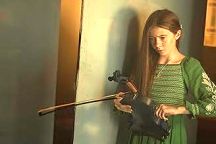 matched by his twinkling conviction in the power of music. Urging her to feel the flow and movement in a composition,
he acts it out with passion – and a jig or two. Music is central to the story; a trip to Knockbally for the competition
heats plays out with fiddle sessions in the pub, busking on the streets and a nervous performance against a local favourite.
Jack may not speak but his crayon sketches provide a colourful record of their big day out.
matched by his twinkling conviction in the power of music. Urging her to feel the flow and movement in a composition,
he acts it out with passion – and a jig or two. Music is central to the story; a trip to Knockbally for the competition
heats plays out with fiddle sessions in the pub, busking on the streets and a nervous performance against a local favourite.
Jack may not speak but his crayon sketches provide a colourful record of their big day out.
- www.screendaily.com
[Allan Hunter]
1h 25m - Director, and Writer: Donncha Gilmore
Produced by Gander Video; Gearoid Gilmore
with: Liath Hannon, Adam Lunnon-Collery, Jenny Maguire, Justin Ensor, Francis O’Mahony, Oisin Flynn and Joseph McGuckian
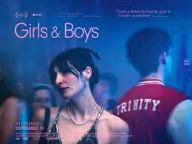 "A chance encounter at a Halloween party leads to unexpected revelations in Donncha Gilmore's feature debut
Girls & Boys. Over the course of one lingering night, Charlie (Liath Hannon)
and Jace (Adam Lunnon-Collery) forge something intimate and meaningful as they wander the streets of Dublin City."
"A chance encounter at a Halloween party leads to unexpected revelations in Donncha Gilmore's feature debut
Girls & Boys. Over the course of one lingering night, Charlie (Liath Hannon)
and Jace (Adam Lunnon-Collery) forge something intimate and meaningful as they wander the streets of Dublin City."
...This film is bathed in nostalgia for classic 90s indie cinema. Charlie and Jace's connection
is reminiscent of Jesse and Céline in Richard Linklater's Before Trilogy or Su Li-zhen and Chow Mo-wan
in Wong Kar-Wai's In the Mood for Love. With a pitch-perfect central pairing, sharp dialogue,
beautiful visuals and essential subject matter, Girls & Boys is simply a cinematic must-see.
Film Ireland
"Liath Hannon shines as Charlie in the new Irish romantic comedy, Girls & Boys.
Girls & Boys tells the story of rugby player Jace meeting
aspiring filmmaker Charlie at a college party. Both attend Trinity, but their worlds couldn’t be
more different — Charlie is trans, her circle full of queer artists and creatives, while Jace sticks with
the more straight-laced camaraderie of his rugby teammates. When the party is suddenly shut down by the Guards,
the two find themselves alone in the streets of nighttime Dublin. As they wander the city, sharing secrets,
dreams, and fears about life after college, a surprising revelation from their shared past threatens
to upend their fragile connection. Jace must confront not only his past,
but the social identity he’s long taken for granted."
accompanying interview
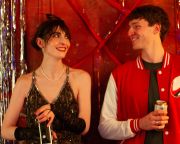 Girls & Boys is the latest independent Irish movie, supported by
Fís Éireann, that deserves its inclusion in the impressive list of home-grown movies of merit.
You can’t help but think of Normal People as this story
brings us back to Trinity College and features a couple who are not mainstream,
but explore the potential of their college years to find their niche.
Girls & Boys is the latest independent Irish movie, supported by
Fís Éireann, that deserves its inclusion in the impressive list of home-grown movies of merit.
You can’t help but think of Normal People as this story
brings us back to Trinity College and features a couple who are not mainstream,
but explore the potential of their college years to find their niche.
Charlie (Liath Hannon) is a young film-maker who has a chance encounter with Jason
(Adam Lunnon-Collery), a business studies student at an illicit Halloween student party.
I had the privilege of seeing Hannon onstage previously in the 2023 International
Dublin Gay Theatre Festival, in the lead role of Garret Baker’s ‘The War Wounded’,
where I awarded the Eva Gore Booth performance award to Hannon. Her progression from stage
to screen is as seamless as it is successful.
Here, Hannon communicates a Charlie with a depth and intrigue that there is more
to this young filmmaker’s story and back story. Hannon’s nonverbal communication is equally clear,
though outwardly, always smiling. We soon discover the real person behind the smiles.
Charlie has quite a story of courage, confidence, love and loss to tell.
Gilmore’s focused screenplay ensures it is told with truth and authenticity.
Jace (Jason) is a beautiful portrayal by Adam Lunnon-Collery, who has a vulnerable
honesty that draws the viewer in. The comparison to Normal People
resonates again, as he visibly struggles to face and accept all the challenges College presents,
on the journey from teenager to young man. The chemistry of the central couple,
the contemporary relevance of the themes discussed, are key to maintaining our interest throughout the 85 minutes.
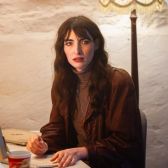 Donncha Gilmore takes on a contemporary story with confidence and skill.
He has clear strengths in both genres as a writer and director. His deliberate unpacking
of contemporary understanding of the experience of trans people and young members of
diverse communities is a real, authentic strength. Many episodes peel back the human experience
of young people who learn that they don’t ‘fit in’. It is interesting that in presenting
valid insights on that journey, in evoking empathy for those who face trans exclusion,
there is little space for Charlie when Jace emotionally verbalises his own adolescent
experiences of being excluded from lad culture because of his vulnerability and friendships.
Charlie doesn’t reciprocate the empathy that Charlie expects.
Donncha Gilmore takes on a contemporary story with confidence and skill.
He has clear strengths in both genres as a writer and director. His deliberate unpacking
of contemporary understanding of the experience of trans people and young members of
diverse communities is a real, authentic strength. Many episodes peel back the human experience
of young people who learn that they don’t ‘fit in’. It is interesting that in presenting
valid insights on that journey, in evoking empathy for those who face trans exclusion,
there is little space for Charlie when Jace emotionally verbalises his own adolescent
experiences of being excluded from lad culture because of his vulnerability and friendships.
Charlie doesn’t reciprocate the empathy that Charlie expects.
We are brought into college rugby culture and the expressions of masculinity, virginity
and emotional disconnection. The bad boy Mark, an arrogant and insecure rugby player
nicely studied by Oisin Flynn, actually treats Charlie worse as a young man,
than Jason did as a boy, but he is shown more understanding. Equally, the school bullies
who impacted both on Charlie and Jason are anonymised as the focus of reflective guilt remains on Jace.
This is a well shot, tender story of change and challenge. There is an appropriate empathy
in its telling and a quality treatment of the screenplay. Locations are familiar to Dublin,
which always adds a welcome connection for Irish audiences. Friendships in this group are strained,
lost, repaired and sustained throughout, ably supported by a strong cast of fellow students
led by Francis O’ Mahony’s loyal Alice.
- nomoreworkhorse.com
117mins - Dir: Trisha Ziff ; Production: 212 Berlin >
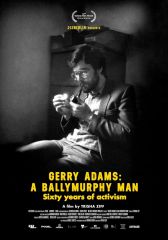 "If you’re expecting a fiery confrontation, Gerry Adams: A Ballymurphy Man
might seem restrained. Trisha Ziff, who shot her footage over five years, lets the former president of Sinn Féin
reflect on his life and times in a documentary that is rooted in long-form interviews.
"If you’re expecting a fiery confrontation, Gerry Adams: A Ballymurphy Man
might seem restrained. Trisha Ziff, who shot her footage over five years, lets the former president of Sinn Féin
reflect on his life and times in a documentary that is rooted in long-form interviews.
Gerry Adams: A Ballymurphy Man lacks critical voices and may well enrage
political opponents. Ziff instead allows Adams to recount his political formation, shaped as it was by violence,
loss and a steadfast rejection of British rule in the North. But her direction is elegant and unfussy,
backed by exemplary archive footage."
- The Irish Times
[Tara Brady]
"Gripping Social Thriller Says You're Never Too Old to Fight Back.
Gerry Adams: A Ballymurphy Man allows the veteran
politician to reflect on 60 years of activism in Northern Ireland, and the long road from incarcerated freedom
fighter to elder statesman. Trisha Ziff’s absorbing documentary reveals a history of Northern Ireland
through one man’s life and proves surprisingly emotional in the message of hope that emerges from Adams’
struggles. Many Irish audiences will welcome the relatively rare opportunity to see Adams talk at length
about his values and motivations. The lessons from the Northern Ireland conflict and the quest for peace
lend the film a wider potential appeal.
Dedicated to the film’s co-producer Ross McDonnell, who died in 2023, this latest documentary
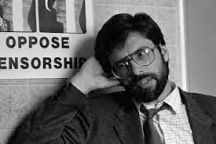 from UK-born, Mexico-based Ziff (Oaxacalifornia: The Return) was filmed over five years
and is firmly based around lengthy interviews with Adams. There are no dissenting voices to challenge
him or tricky questions to navigate. He is relaxed and affable, giving a thoughtful assessment
of the past and his part in bringing Northern Ireland from war to peace."
- Screen Daily
[Allan Hunter]
from UK-born, Mexico-based Ziff (Oaxacalifornia: The Return) was filmed over five years
and is firmly based around lengthy interviews with Adams. There are no dissenting voices to challenge
him or tricky questions to navigate. He is relaxed and affable, giving a thoughtful assessment
of the past and his part in bringing Northern Ireland from war to peace."
- Screen Daily
[Allan Hunter]
"Adams was president of Sinn Féin from 1983 to 2018, and was a critical voice
in the decision taken by the IRA to lay down their arms after 25 years of conflict in Northern Ireland
and in the signing of the Irish peace accord, the Good Friday Agreement, in 1998.
The documentary sees Adams tell his story, reflecting on 60 years of activism in Northern Ireland,
from prisoner to elder statesman."
- screendaily.com
[Mona Tabbara]
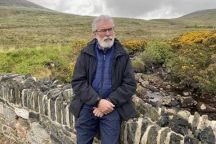 Irish republican leader, Gerry Adams is one of the most controversial political leaders and visionaries
of our time, he led the people of the North of Ireland from conflict to peace, (1968-1994).
Adams was a critical voice in the decision taken independently by the IRA to lay down their arms
after their twenty-five-year war against the British. Imprisoned and shot, he was demonized and censored
by dominant media as a subversive and terrorist – yet in the end the British and their allies were forced
to recognize his legitimacy and negotiate with him and his party Sinn Féin, the Irish peace accord,
‘The Good Friday Agreement’.
Irish republican leader, Gerry Adams is one of the most controversial political leaders and visionaries
of our time, he led the people of the North of Ireland from conflict to peace, (1968-1994).
Adams was a critical voice in the decision taken independently by the IRA to lay down their arms
after their twenty-five-year war against the British. Imprisoned and shot, he was demonized and censored
by dominant media as a subversive and terrorist – yet in the end the British and their allies were forced
to recognize his legitimacy and negotiate with him and his party Sinn Féin, the Irish peace accord,
‘The Good Friday Agreement’.
Today he is an elder statesman supporting the next generations on their peaceful and inclusive
path toward Irish unity. An intensely private man protecting his family from the public eye,
this is the first time, he tells his story. Interwoven with his words, a wealth of imagery of
what is one of the most documented conflicts of our time giving an insight into Adams’ world,
relaxed, informal, and uncensored.
- International Documentary Association (IDA)
 Early in the film, Adams asserts that “politics is not worth anything unless it empowers people”.
Over the next two hours, that is confirmed as a guiding philosophy for someone who has always displayed
the courage of his convictions and taken action when he sees injustice and oppression.
A Ballymurphy Man traces the evolution of Adams’ political beliefs,
but also provides some insight into his personal life. He recalls family life in the late 1940s
and ’50s with portraits of relatives and places that feel positively Dickensian.
He pays tribute to the influence of his grandmother, a millworker who introduced Adams
to the joys of reading and the importance of education. He was just 15 when he read
the Special Powers Act of 1922, which granted the authorities extensive controls to maintain peace and order.
Early in the film, Adams asserts that “politics is not worth anything unless it empowers people”.
Over the next two hours, that is confirmed as a guiding philosophy for someone who has always displayed
the courage of his convictions and taken action when he sees injustice and oppression.
A Ballymurphy Man traces the evolution of Adams’ political beliefs,
but also provides some insight into his personal life. He recalls family life in the late 1940s
and ’50s with portraits of relatives and places that feel positively Dickensian.
He pays tribute to the influence of his grandmother, a millworker who introduced Adams
to the joys of reading and the importance of education. He was just 15 when he read
the Special Powers Act of 1922, which granted the authorities extensive controls to maintain peace and order.
Adams’ childhood and adolescence were lived in a Northern Ireland that he came to view
as a land colonised by an England that pursued a policy of divide and rule. Dehumanising the population,
labelling them barbarians in need of civilisation and denying human rights are moves
repeated throughout history and acutely familiar from conflicts that still rage around the world.
His analysis allows us to comprehend why his life has been devoted to the
“reconquest of Ireland by the people who live here”.
Adams’ story is illustrated by a feast of archive footage that includes photos from his family albums,
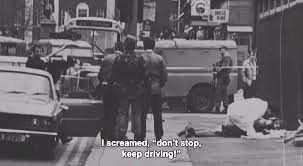 home movies and extensive use of reporting on what became known as the Troubles.
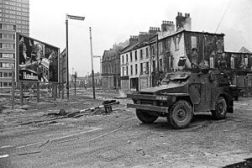
Evocative black-and-white images of communities under siege, barricaded areas of Belfast,
British troops on the streets, curfews and resistance convey the reality of a world
that Adams compares to Apocalypse Now.
home movies and extensive use of reporting on what became known as the Troubles.
Evocative black-and-white images of communities under siege, barricaded areas of Belfast,
British troops on the streets, curfews and resistance convey the reality of a world
that Adams compares to Apocalypse Now.
He also speaks of his time in prison, the hunger strikes of the early 1980s,
the death of IRA figure Bobby Sands and his own election as MP for West Belfast in 1983.
There is no bitterness in his reflections. Recalling one of the attempts on his life,
he observes drily: “I’ve been blessed with very bad assassins.”
There is also personal insight into Adams’ meetings with SDLP leader John Hume,
the efforts that eventually brought the Good Friday Agreement of 1998 and the chance for peace
to take root in Northern Ireland. There is so much to cover here that the documentary
could easily have been longer. Its achievement is to further the understanding of a
once-controversial figure, whose life provides a window into a much wider movement
and how the fiercest of conflicts can ultimately find a way to resolution.
- Screen Daily
[Allan Hunter]
1h 34m - Dir: Brendan Canty; writer Alan O'Gorman; Produced by Wayward Films, Sleeper Films with Danny Power and Diarmuid Noyes alongside Emma Willis, Alison Oliver, Chris Walley, and Helen Behan
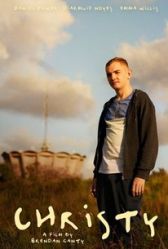 "Here is a terrifically warm and involving Irish movie about two brothers from Cork’s northside;
it is moving and funny, with plenty of affectionate shots of the iconic Knocknaheeny water tower
looming futuristically over the skyline like a 70s spaceship or one of eastern Europe’s
Soviet-era war memorials. Screenwriter Alan O’Gorman and first-time feature director and
story co-creator Brendan Canty deliver a social-realist film with heart, featuring
outstanding performances of sympathy and strength, developed from Canty’s 2019 short film of the same name.
It’s tough, but capable of delicacy and succeeds in conveying something very difficult
to achieve without sentimentality: love of your home town. You can come for the drama
and stay for the cheeky hip-hop sequence over the closing credits, a final stretch of sweetness
and fun that the movie has more than earned, and which Canty, a former music video director,
is more than capable of putting together.
"Here is a terrifically warm and involving Irish movie about two brothers from Cork’s northside;
it is moving and funny, with plenty of affectionate shots of the iconic Knocknaheeny water tower
looming futuristically over the skyline like a 70s spaceship or one of eastern Europe’s
Soviet-era war memorials. Screenwriter Alan O’Gorman and first-time feature director and
story co-creator Brendan Canty deliver a social-realist film with heart, featuring
outstanding performances of sympathy and strength, developed from Canty’s 2019 short film of the same name.
It’s tough, but capable of delicacy and succeeds in conveying something very difficult
to achieve without sentimentality: love of your home town. You can come for the drama
and stay for the cheeky hip-hop sequence over the closing credits, a final stretch of sweetness
and fun that the movie has more than earned, and which Canty, a former music video director,
is more than capable of putting together.
Where another type of movie might have a gravitational pull towards disaster and despair,
this one doesn’t; equally, though, it’s under no illusions. There’s always a heartbeat of humour,
especially when Christy helps out with painting jobs; he and dopey fellow painter Trevor (Chris Walley)
can’t resist weighing themselves on a well-off client’s hi-tech digital scales in his bathroom –
synced to the client’s Fitbit, which then goes crazy. It’s a smart, likable picture."
- The Guardian
[Peter Bradshaw]
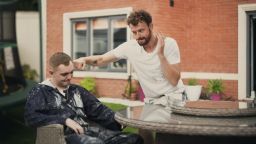 "Against the vibrant background of Cork’s cityscape, Christy (Danny Power) is ageing out of care,
and as his 18th birthday draws ever closer, he finds himself caught between two worlds.
This feature debut from director Brendan Canty evolved from a short of the same name.
Now, with this longer medium, Canty finds strong footing while breathing extended life
into this ensemble of authentic, complex characters.
"Against the vibrant background of Cork’s cityscape, Christy (Danny Power) is ageing out of care,
and as his 18th birthday draws ever closer, he finds himself caught between two worlds.
This feature debut from director Brendan Canty evolved from a short of the same name.
Now, with this longer medium, Canty finds strong footing while breathing extended life
into this ensemble of authentic, complex characters.
 A festival success, Christy screened at
Karlovy Vary International Film Festival, Transylvania International Film Festival and Galway Film Fleadh.
There it won Best Irish Feature to sit next to the coveted Grand Prix prize they picked up at Berlinale for their premiere.
A festival success, Christy screened at
Karlovy Vary International Film Festival, Transylvania International Film Festival and Galway Film Fleadh.
There it won Best Irish Feature to sit next to the coveted Grand Prix prize they picked up at Berlinale for their premiere.
Christy peels away the constructed realities of privilege,
with this beautifully observed slice of life. This is a powerhouse debut not only from Canty
but also from the young lead, Danny Power. There’s a raw freshness to their voices and collaboration.
Christy is the sort of first feature that makes you excited -
not just to see where these talented creatives go - but for the promising future of indie cinema."
- Film Ireland
[Niall McCloskey]
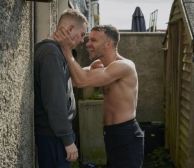
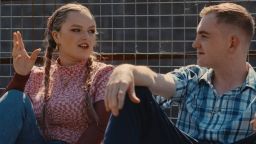 17-year-old Christy is at a crossroads. Kicked out of his suburban foster home, he moves in
with his estranged older brother Shane and his young family. As far as Shane is concerned
this is a temporary arrangement, but Christy begins to feel at home on Cork's working-class Northside.
As he makes friends and begins to let the community in, he also reconnects with his past
through his seemingly more corrupting extended family, despite Shane’s efforts to protect him.
Shane wants something better for Christy at any cost – even if it means he has to push him away.
As the brothers look to reconcile their turbulent past, their family and the community around them
offer hope for Christy’s future.
17-year-old Christy is at a crossroads. Kicked out of his suburban foster home, he moves in
with his estranged older brother Shane and his young family. As far as Shane is concerned
this is a temporary arrangement, but Christy begins to feel at home on Cork's working-class Northside.
As he makes friends and begins to let the community in, he also reconnects with his past
through his seemingly more corrupting extended family, despite Shane’s efforts to protect him.
Shane wants something better for Christy at any cost – even if it means he has to push him away.
As the brothers look to reconcile their turbulent past, their family and the community around them
offer hope for Christy’s future.
Bursting with humour, soul, and raw authenticity, the film stars breakout talent Danny Power
and Diarmuid Noyes alongside a brilliant Irish ensemble including Emma Willis, Alison Oliver,
Chris Walley, and Helen Behan.
The film also features members of Cork’s Kabin Studio, the arts collective behind The Spark —
the 2024 viral hit with over 1 billion views, dubbed the “song of the summer” by The New York Times.
We again have the pleasure of opening our Short Films evening with the latest from G.Scott MacLeod in his History of Griffintown series.

98 min - Dir: Éamon Little with Patrick & Gladys Lydon
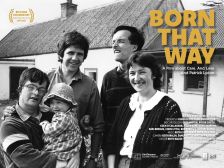 Best Irish Documentary - Dublin International Film Festival 2025, Dublin Critics Circle Award.
Desperately moving and beautifully made. Essential viewing. ***** Donald Clarke, Irish Times.
An intimate portrait of extraordinary people - Sunday Independent.
Inspirational story of humility and love of community – Film Ireland.
A documentary film about care. and love. and Patrick Lydon.
In a small wooden house in County Kilkenny, Ireland, Patrick Lydon’s life is ebbing away.
Throughout his final year he reflects on an extraordinary life that took him from a budding career
in rock journalism in America to trailblazing, with his wife, Gladys, the development in Ireland
of the radically inclusive Camphill Movement, sharing life in community with people of diverse needs
and abilities. At a time when it couldn’t be more needed, Patrick’s story and his unique lens
on the world ask searching questions about ideas of community and inclusion and
shine a special light on the otherness of others in our society.
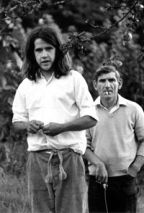 "Patrick Lydon is a rare bird. A ‘social artist’, his raw materials are human relations.
He is a man of vision, intelligence, principle, discipline, huge energy, passion, courage,
humour and, most obvious of all, he’s bursting with love for his fellow man,
especially the more vulnerable amongst us.
"Patrick Lydon is a rare bird. A ‘social artist’, his raw materials are human relations.
He is a man of vision, intelligence, principle, discipline, huge energy, passion, courage,
humour and, most obvious of all, he’s bursting with love for his fellow man,
especially the more vulnerable amongst us.
An idealistic intellectual growing up in a high-achieving family in Boston in the 1960s
and fuelled by rock ‘n roll, he was destined for a career in rock journalism.
By 19 he had reported for the New York Times on The Rolling Stones in Hyde Park and on Woodstock.
But a deeper disenchantment with American culture, and then a call to arms in Vietnam,
took him instead to Ireland, where his discovery of the Camphill Movement,
and with it the love of Gladys Kinghorn, changed his destiny,
gave him his vocation and made him the legend he became."
- filmmakerscollab.org
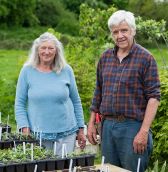 "Unfolding as a reflection on his life, the documentary charts the final year of Patrick Lydon,
co-founder (with his wife Gladys) of the Camphill Community at Ballytobin, Callan,
County Kilkenny, in 1979. Poignantly drawing from memories, photographic mementoes and
archival material, this inspirational story of humility and love of community is woven.
Director Éamon Little draws an impression of a man more concerned with service to others
than recognition and accolades. Lydon and Gladys downplay their hard work,
the pioneering spirit underpinning groundbreaking innovation and achievements."
- filmireland.net
[Mutale Kampuni]
"Unfolding as a reflection on his life, the documentary charts the final year of Patrick Lydon,
co-founder (with his wife Gladys) of the Camphill Community at Ballytobin, Callan,
County Kilkenny, in 1979. Poignantly drawing from memories, photographic mementoes and
archival material, this inspirational story of humility and love of community is woven.
Director Éamon Little draws an impression of a man more concerned with service to others
than recognition and accolades. Lydon and Gladys downplay their hard work,
the pioneering spirit underpinning groundbreaking innovation and achievements."
- filmireland.net
[Mutale Kampuni]
"In 1976 Lydon went on a work placement to Camphill Newton Dee, Aberdeen and met Gladys Kinghorn.
They were married soon after, and in 1978 they responded to a request from parents
seeking a new community for autistic children in Ireland. This was the beginning of
the Camphill Community in Callan, Kilkenny and lifelong mission and passion of Patrick and Gladys.
Gladys explains life sharing, based in largely self-sustaining organic farms and gardens,
and says, ‘...Nobody got paid. People coming to live here found their lives enriched.
“Cared for”, “carers” and “service provision” were alien concepts. All were equal citizens,
each contributing according to ability.’
Little’s personal experience and friendship with the family communicates the connection
and special position afforded to those who came to live and work at the Camphill Community.
He describes how he saw Patrick ‘...as a sort of social artist – human relations were his material,
making surprising connections his modus operandi. Far from po-faced or
holier-than-thou, he got his kicks from what he did.’"
- filmireland.net
[Mutale Kampuni]
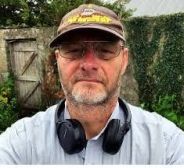 Born on 12th July 1950 to an Irish family in Massachusetts (USA), Lydon was the youngest
of six children. His formative years at home played a major role in what was later to become
his life’s calling. When her husband (Patrick senior) was forced to retire from his work
due to illness, his mother Alice took charge of the family fortunes, moving them to a small,
subsistence farm during the first three years of Lydon’s life. Against that backdrop
of a seemingly simple existence, Alice also advocated a principle of ‘high achieving intellectualism’
and education for her children. With no financial muscle behind them, they were enrolled
into prestigious schools by way of attaining scholarships.
Born on 12th July 1950 to an Irish family in Massachusetts (USA), Lydon was the youngest
of six children. His formative years at home played a major role in what was later to become
his life’s calling. When her husband (Patrick senior) was forced to retire from his work
due to illness, his mother Alice took charge of the family fortunes, moving them to a small,
subsistence farm during the first three years of Lydon’s life. Against that backdrop
of a seemingly simple existence, Alice also advocated a principle of ‘high achieving intellectualism’
and education for her children. With no financial muscle behind them, they were enrolled
into prestigious schools by way of attaining scholarships.
At age 16, Lydon was accepted on a full scholarship as a student of Exeter Academy
in New Hampshire, where he was introduced to the work of Dostoevsky and The Brothers Karamazov.
The wisdom he found in these writings was to serve him into the future as his ‘raison d’être’
in the Camphill Community. He moved on to Yale where he spent two years and was on course
to follow a career in music (rock) journalism. Lydon availed of opportunities to report
for the New York Times on rock and roll events by the Rolling Stones in Hyde Park and Woodstock.
Around the same time, he was becoming increasingly disillusioned with American culture
and its politics of entrenched racism, value system, glorification of the military
and industrialisation. Being conscripted into the Vietnam War was the deciding factor
for leaving the country. He deferred being drafted, to be called up once his studies ended,
and left to study at Trinity College, Dublin. This stay in Ireland was to encompass all of fifty years.
In 1972 Lydon came upon the Camphill Community in Duffcarrig, Co Wexford,
which was just getting off the ground, and the first in the country. Lydon said he found
his life's mission here and states, ‘There, a door opened, and I went through it.’
Due importance is given to the origins of the Camphill Movement in 1940 in Aberdeen, Scotland,
which was founded by a group of war refugees. Under the leadership of Dr Karl König
and inspired by the teachings of Rudolf Steiner, with particular emphasis on the potential,
education, integration and spiritual integrity of all, regardless of physical or
intellectual ability, they established the community to provide a ‘healing environment’
and develop a new way of life for children with special needs.
The documentary explains how the community's model involves co-workers and individuals
with disabilities living and working together in a family-like setting, emphasising mutual respect
and a holistic approach to care. Lydon fully embraced these values and highlights in the documentary
the denial of the human rights of children with exceptional needs. He states,
‘Their issues are not health issues, they are who they are.’
- filmireland.net
[Mutale Kampuni]
1h 31min - Dirs and Writers: Damian McCann, Sarah Gordon; Produced by Orfhlaith Ni Chearnaigh and Christopher Myers
with Carrie Crowley, Brid Brennan, Eva-Jane Gaffney
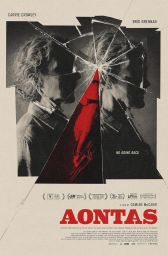 "Aontas, a new Irish language heist thriller from director
Damian McCann (Doineann), has been selected for the Santa Barbara International Film Festival
where it will make its world premiere. IFTN is premiering an exclusive clip from the film.
"Aontas, a new Irish language heist thriller from director
Damian McCann (Doineann), has been selected for the Santa Barbara International Film Festival
where it will make its world premiere. IFTN is premiering an exclusive clip from the film.
Written by Sarah Gordon and Damian McCann, the film stars Carrie Crowley
(An Cailin Ciuin, Smother), Brid Brennan (Shadow Dancer, Doineann) and Eva-Jane Gaffney
(Kin, Harry Wild). Aontas will debut tomorrow, February 12th, in Santa Barbara, California.
The film will have its Irish premiere at DIFF on February 22nd.
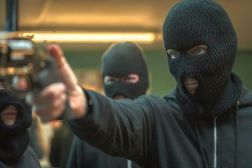
Three unlikely thieves, led by a woman on the verge of a breakdown, rob a rural
Irish Credit Union. Opening in the tragic aftermath of the heist-gone-wrong, Aontas unfolds backwards,
chapter by chapter to unravel the events that led to this point. What starts as
a poorly executed robbery becomes a portrait of a wilful woman trapped in her own past."
- IFTN
[Luke Shanahan]
 "There are plenty of reasons to attend the San Luis Obispo International Film Festival this year,
but if you only catch one feature, make it Aontas. Quiet, smart,
and beautifully executed, it’s a perfect fit for a festival that celebrates craft.
"There are plenty of reasons to attend the San Luis Obispo International Film Festival this year,
but if you only catch one feature, make it Aontas. Quiet, smart,
and beautifully executed, it’s a perfect fit for a festival that celebrates craft.
There’s something mesmerizing about how Aontas unfolds,
moving backward through time, each scene revealing a new glimmer of truth or deeper layer
to the mystery. The structure immediately reveals itself, and from the opening shot, I was hooked.
The film doesn’t just tell a story of a botched robbery. It explores how even
the most unassuming moments can carry tremendous weight, once we know the context."
- SLOIFF
[Emma Metzger Stewart]
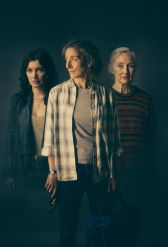 The film isn’t simply moving backward, it’s pulling us deeper into a story that’s been hiding in plain sight.”
Aontas is one of those rare films that rewards close attention
without ever feeling like it’s testing you. It lingers in silence, trusts its audience,
and quietly pulls the rug out again and again, proving it doesn’t require flashy twists
to affect devastating revelations. That’s its power: it invites you to breathe in the atmosphere
before it tells you why you’re holding your breath.
The film isn’t simply moving backward, it’s pulling us deeper into a story
that’s been hiding in plain sight. The loveliness of the film is in discovering what that something is.
The cast is uniformly excellent, with performances that feel as lived-in and authentic
as the film’s setting. A look that seems one way, becomes something else entirely in the next sequence.
It’s a kind of emotional reverse-engineering.
Every detail, once understood, feels like it was sitting there all along,
waiting to be seen correctly.
 There’s something incredibly immersive about being allowed to just watch,
to sit with the characters in their messy interactions. Early on, it feels like an uneasy portrait
of small-town life. Familiar. These are characters who feel like people you might actually know,
people you nod to at the farmer’s market, who might stop to chat about their dog or the weather.
There’s something incredibly immersive about being allowed to just watch,
to sit with the characters in their messy interactions. Early on, it feels like an uneasy portrait
of small-town life. Familiar. These are characters who feel like people you might actually know,
people you nod to at the farmer’s market, who might stop to chat about their dog or the weather.
Director and co-writer (with Sarah Gordon) Damian McCann never allows
Aontas to rely on spectacle. Its greatest mysteries are ones
you might walk past without noticing. These are the details that build and break open the mystery.
You’ll get the sense that the answers are right in front of us, if we only knew how to read them.
That every object, every gesture, might be a clue.
By the time the film ends I found myself reeling not just from the revelations,
but from how deeply I’d come to care about how easily our view of someone can shift
when we learn the truth. Or think we do.
Watch Aontas, and you’ll leave the theater wanting to talk about it.
- SLOIFF
[Emma Metzger Stewart]
1h 39m - Dir and writer: Sinéad O’Shea; Produced by: SOS Productions with: Edna O’Brien; Jessie Buckley (diary and memoir readings), Gabriel Byrne, Walter Mosley
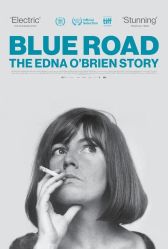 "Emerging from rural Ireland, Edna O’Brien broke multiple taboos with her sexually provocative
literature and equally adventurous love life. Here, she opens up about her past
with additional perspectives offered by Gabriel Byrne, Walter Mosely, and others.
"Emerging from rural Ireland, Edna O’Brien broke multiple taboos with her sexually provocative
literature and equally adventurous love life. Here, she opens up about her past
with additional perspectives offered by Gabriel Byrne, Walter Mosely, and others.
Edna O’Brien defied Ireland’s patriarchal and religious constraints with her
sexually frank 1960 debut novel, The Country Girls. She became a literary sensation,
writing for The New Yorker, delivering provocative interviews, authoring screenplays,
and hosting star-studded parties. She was as prolific in conducting love affairs
as she was writing novels. She made a fortune and lost a fortune.
Filmmaker Sinéad O’Shea taps into a wealth of material including unpublished diaries,
decades of television appearances, and new interviews with O’Brien, in her 90s
and as incisive as ever. We hear from her sons Carlo and Sasha about their unconventional
upbringing with a divorced mother whose house guests included Marlon Brando, Judy Garland,
and Paul McCartney. The actor Gabriel Byrne explains how O’Brien broke taboos
while writer Walter Mosely describes how she changed his life as his teacher.
The film is as candid and as pleasurable as O’Brien’s novels, including a section about
her tumultuous affair with a married British politician. She doesn’t shy away from any topic.
The light may have dimmed on her celebrity, but this documentary is a revelation
and especially poignant after her death in July."
- TIFF
[Thom Powers]
"With the release of her revolutionary 1960 novel ‘The Country Girls’, Edna O’Brien sealed her fate as both a revered novelist and a feminist icon. Blue Road explores her life as a literary sensation and social radical." - with trailer
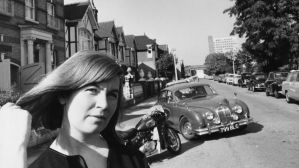 "One of Ireland’s most important novelists and a woman of fierce intelligence
and bravery is celebrated in Sinéad O’Shea’s thoroughly enjoyable documentary.
"One of Ireland’s most important novelists and a woman of fierce intelligence
and bravery is celebrated in Sinéad O’Shea’s thoroughly enjoyable documentary.
Sinéad O’Shea’s documentary portrait of the author Edna O’Brien is a reminder
that most writers – most people, in fact – don’t have lives anywhere near as exciting
or fulfilling as hers. The film, with diary entries read by Jessie Buckley, shows us that
O’Brien was always a witty, generous and good-humoured interviewee over the years;
this film includes an extended interview with the author herself just before her death last year
at the age of 93, in which she speaks with a softly sibilant but beautiful voice,
her natural prose-poetry never deserting her."
- The Guardian
[Peter Bradshaw]
‘The best place to see Edna O’Brien was at Mass’: the banned and burned author’s complex
relationship with Ireland.
While Edna O’Brien’s debut novel The Country Girls was denounced from the pulpit
in her Co Clare hometown, it is only half of a more complicated story.
Every tribute paid to the late Irish writer Edna O’Brien has mentioned two words:
banned and burned.
While the oft-told tale of her debut novel The Country Girls being denounced
from the pulpit and possibly burned in her hometown of Tuamgraney, Co Clare,
creates a powerful image, it is only half of a much longer and more complex story.
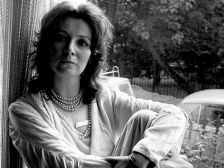
Her feelings towards her homeplace were clear in the early 1960s,
after her debut novel was banned. “I often wonder why, when Cromwell said
‘To hell or to Connaught’, he didn’t include Clare,” she told the Guardian in 1962.
Neither did she feel welcomed in the capital, where the Dublin-based
censorship board went on to ban her two follow-up books, and political and
religious figures queued up to critique the books’ sexual imagery.
Yet, according to locals in east Clare, the easiest way to catch
a glimpse of O’Brien in recent years was to look out for her at Sunday Mass
in that very same village church.
She may have had to leave her home in order to write about it,
but those who knew her say her home was always in Tuamgraney.
She had a deep love for the place and its people, and the feeling was very much mutual.
- The Irish Times
[Andrew Hamilton]
 click here!